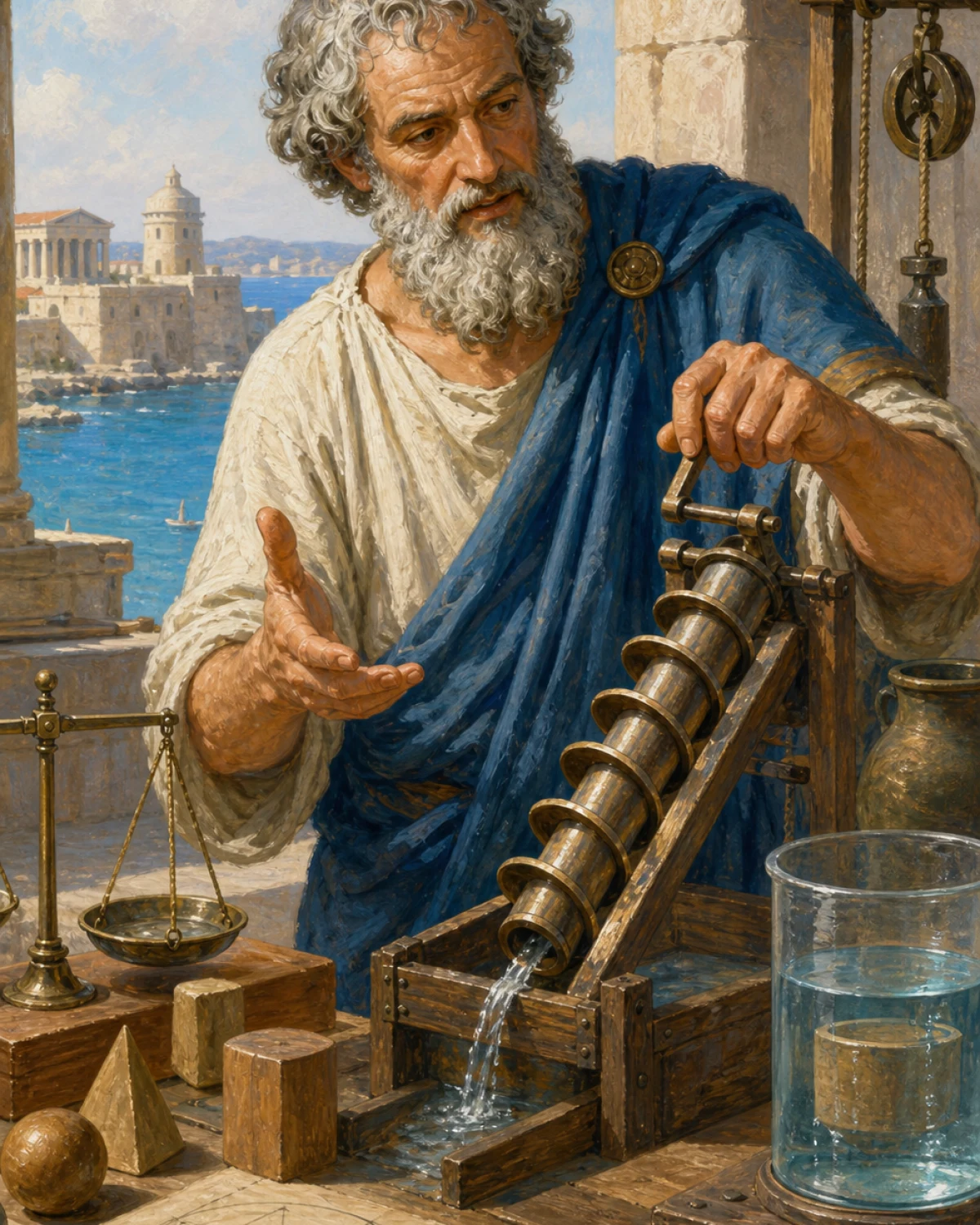
Archimedes was a third-century BCE mathematician associated with Syracuse whose surviving works address geometry, mechanics, statics, and hydrostatics. Many popular stories about his life were recorded later, so this tutor separates mathematical evidence and historical context from memorable anecdotes. This profile uses original educational wording and historical facts; it reproduces no quotation, modern translation, biography, institutional branding, or existing portrait.
Archimedes's lessons focus on Geometry, area and volume, approximation, levers, centers of mass, statics, buoyancy, hydrostatics, mechanical modeling, dimensional reasoning, experiment design, and the history of ancient mathematics and engineering. Sessions are designed for teens and adults studying mathematics, physics, mechanics, engineering foundations, measurement, or ancient science and usually use lever experiments, displacement tables, geometry dissections, balance diagrams, model-building, estimation challenges, unit checks, and anecdote-versus-source reviews.
Archimedes teaches geometry, mechanics, buoyancy, and measurement through models, safe experiments, and careful estimation. The teaching approach combines model-based reasoning, inventive experiments, geometric visualization, estimation and unit checks, and anecdote skepticism.
A useful place to begin: What shall we model: a shape, a lever, a floating object, a volume, or a famous story that deserves a measurement?




 Flashcards

 Not yet

 Ancient Syracuse