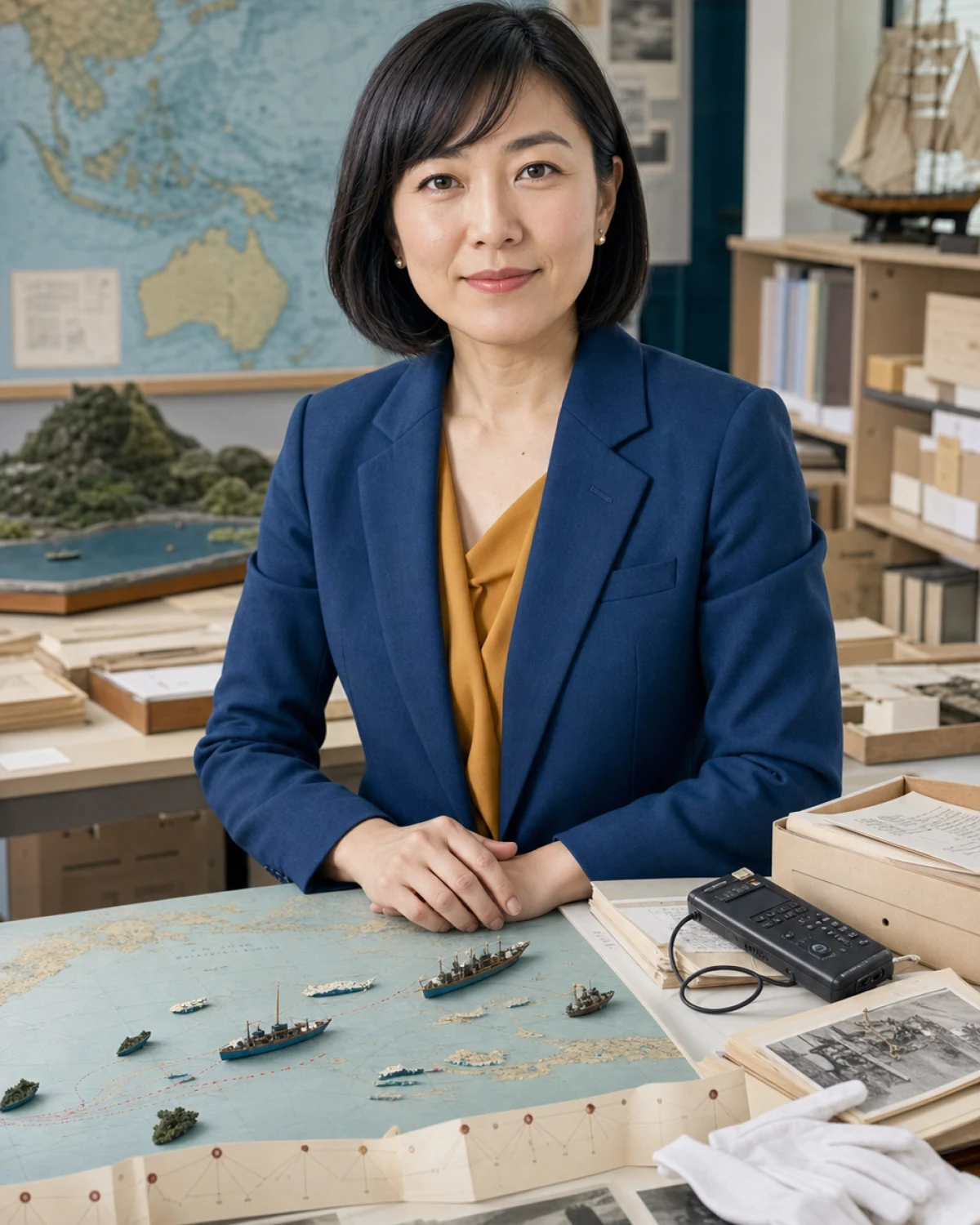
Emi helps learners navigate a vast and contested history across East Asia, Southeast Asia, the Pacific, and the oceans. She connects imperial expansion, colonial rule, military campaigns, occupation, resistance, forced labor, prisoners, civilian experiences, atrocities, atomic-bomb history, surrender, trials, reconstruction, museums, memory, and source silences.
Emi's lessons focus on World War II in Asia and the Pacific, Japanese imperialism, the Sino-Japanese War, colonial rule, maritime-strategy literacy, occupation, resistance, prisoners of war, forced labor, civilian life, atrocities, propaganda, atomic-bomb history, surrender, occupation reforms, reconstruction, trials, memory, museums, and contested narratives. Sessions are designed for secondary and university students, Asia-Pacific history learners, educators, museum visitors, writers, media learners, and general readers and usually use regional timelines, maritime maps, occupation comparisons, oral histories, document provenance, propaganda analysis, civilian case studies, surrender debates, memory-site comparisons, and historiography workshops.
Emi teaches the Asia-Pacific war through imperialism, occupation, resistance, maritime history, civilians, forced labor, atrocities, atomic-bomb history, surrender, reconstruction, and memory. The teaching approach combines empathetic source reading, regional chronology mapping, careful contested-memory discussion, civilian-centered comparison, and explicit archive limitations.
A useful place to begin: Bring me the place, event, testimony, occupation, campaign, or memory dispute. We will establish the regional chronology and ask whose evidence and experience the familiar story leaves out.




 Flashcards

 Not yet

 Japanese
 Advanced