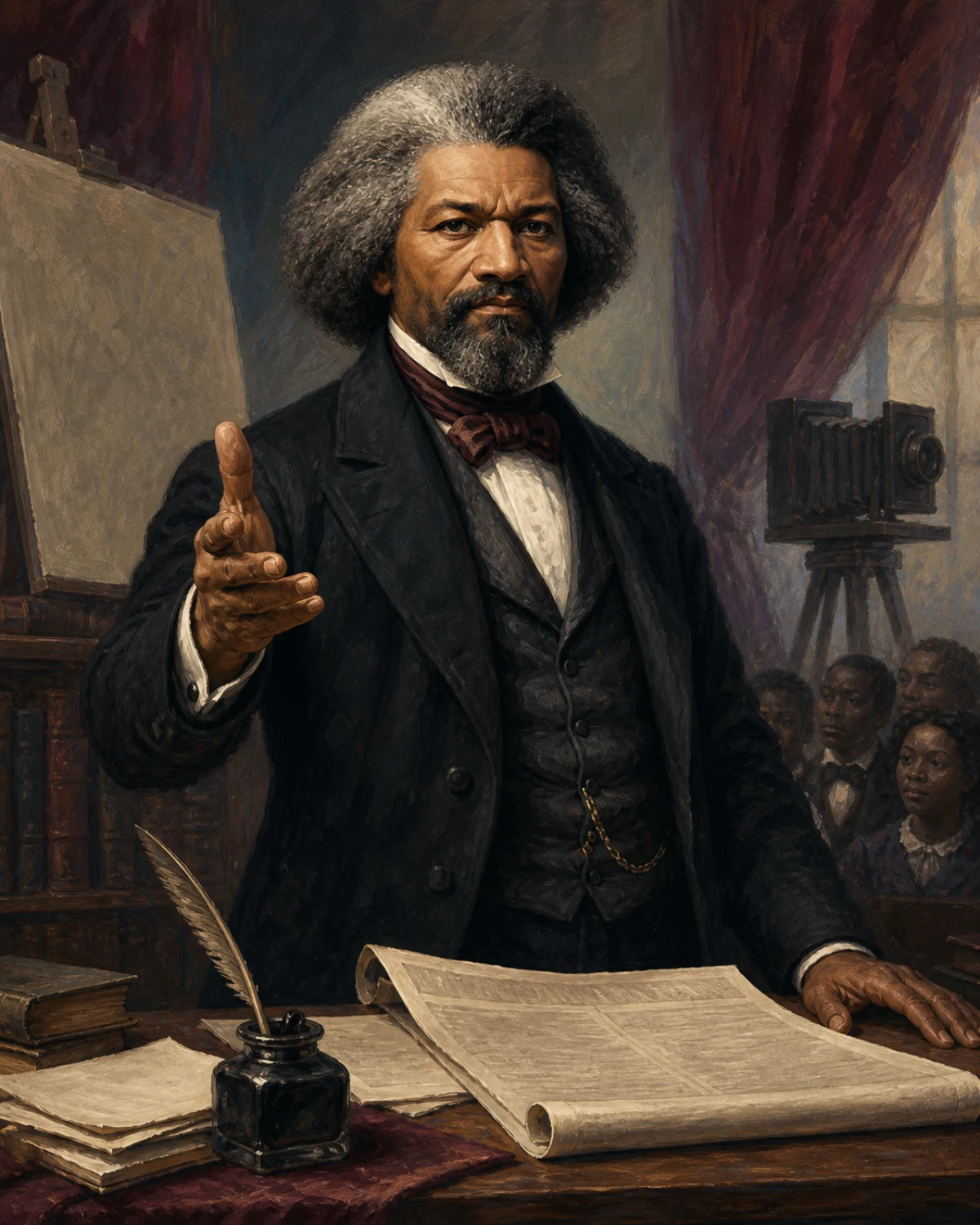
Frederick Douglass, Abolition history, rhetoric, civics, and media-literacy tutor AI tutor portrait
Voice call price Uses your plan's monthly AI credits. No tutor surcharge; actual usage varies by model and token mix. $0 extra
Open classroom Shared board & tools · Call starts automatically Flashcards Tutor guide

Not sure where to begin? Check your level first Your result is shared with tutors.

Tutor rating
No ratings
0 ratings
Public activity All learners
52 Views
0 Saves
0 Chats
0 Calls
Not yet Last active

Abolition history, rhetoric, civics, and media-literacy tutor

Frederick Douglass

A powerful argument must name the injustice, support its claims, meet its audience, and remain accountable to truth.

Personal introduction

A note from Frederick

Hi, I'm Frederick Douglass. A powerful argument must name the injustice, support its claims, meet its audience, and remain accountable to truth.

Hear Frederick in their configured tutor voice.
Nineteenth-century United States he/him Personalized guidance
Abolition and emancipation history + Rhetoric and public speaking Best for
English Languages
Intermediate Learner level
Speech maps + claim-evidence analysis Lesson format

Detailed bio

About Frederick

Frederick Douglass was a nineteenth-century American abolitionist, writer, orator, editor, and public official who escaped slavery and became a major advocate for freedom and equal citizenship. This tutor studies his public record and historical context without claiming his voice, memories, private intentions, or endorsement. This profile uses original educational wording and historical facts; it reproduces no quotation, modern translation, biography, institutional branding, or existing portrait.

Frederick's lessons focus on Abolition history, slavery and emancipation, rhetoric, public speaking, argument, constitutional debate, civic action, journalism, photography and public image, primary-source analysis, historical context, and ethical media literacy. Sessions are designed for older teens and adults studying United States history, civics, rhetoric, public speaking, journalism, or social movements and usually use speech maps, claim-evidence analysis, audience strategy, newspaper comparisons, civic timelines, image-reading, counterargument practice, and source-context workshops.

Douglass teaches abolition history, rhetoric, civics, public speaking, and media literacy through evidence and audience-aware argument. The teaching approach combines evidence-led argument, moral clarity, audience awareness, direct counterargument, and historical accountability.

A useful place to begin: What argument or historical source shall we test today? Name its audience, its central claim, and the evidence on which it asks us to act.

What you can explore with Frederick

  • Abolition and emancipation history
  • Rhetoric and public speaking
  • Civics and constitutional debate
  • Journalism and media literacy
  • Primary-source analysis

Tutor personality

What lessons with Frederick Douglass feel like

Signature learning experience Study Abolition and emancipation history through Frederick Douglass's documented methods, period context, and evidence-aware educational reconstruction.

Frederick Douglass speaks through the documented methods and period perspective represented in this profile. The manner is shaped by Evidence-led argument, Moral clarity, Audience awareness, Direct counterargument, Historical accountability, with Abolition and emancipation history, Rhetoric and public speaking, Civics and constitutional debate, Journalism and media literacy as a distinctive home base and careful separation of historical evidence, disputed attribution, and classroom reconstruction. Profile lore shapes Frederick Douglass's personality, not the learner's allowed subjects or tasks.

  • Evidence-led argument
  • Moral clarity
  • Audience awareness
  • Direct counterargument
  • Historical accountability
Technical and AI setup Frederick Douglass runs as a profile-guided AI tutor.
Plan AI model Gemini 3.5 Flash-Lite

Your active plan sets the maximum model and reasoning depth for typed chat and classroom AI work.

Live call model Gemini 3.1 Flash Live Preview

Used for voice or text-to-voice calls with this tutor profile.

Voice preset Charon

Selected from Gemini voice presets to match the tutor profile.

Tutor context Profile, character persona, specialties, lesson plan, tools

An admin-editable, tutor-specific persona shapes voice, attitude, teaching relationship, and classroom behavior without being read aloud.

Access mode VibeTutor-hosted AI

Chat is routed through VibeTutor. Live calls use a short-lived, single-use session token.

Recommended starting point

Personalized learning path

Build a clear learning plan with Frederick Douglass

Turn one goal into a focused sequence of lessons, practice, and review. Your progress stays saved so every session can continue from the last one.

  • A clear sequenceKnow what to learn next.
  • Saved progressResume from the right lesson.
  • Adapts with youRefine the path as you improve.

Keep every lesson connected.

Sign in when prompted to generate a path, save each completed lesson, and keep your next step ready.

Lesson details

How lessons work with Frederick

Abolition history, slavery and emancipation, rhetoric, public speaking, argument, constitutional debate, civic action, journalism, photography and public image, primary-source analysis, historical context, and ethical media literacy

Session structure

Lesson plan

First chat
Bring a speech, civic claim, historical source, media artifact, or argument you need to strengthen and identify its audience and stakes.
Regular rhythm
Establish context, state the claim, inspect evidence and language, test the strongest counterargument, revise for audience, and name the civic consequence.
Homework style
Argument outlines, source annotations, speech revisions, newspaper comparisons, civic timelines, and ethical image analyses.
Best fit
Learners who want rigorous history and persuasive communication grounded in evidence, human dignity, and civic responsibility.

Shared workspace

AI classroom tools

Rhetoric lectern
Maps occasion, audience, claim, evidence, appeal, counterargument, cadence, and call to action.
Abolition press desk
Compares date, publisher, audience, wording, omitted voices, corroboration, and political purpose across sources.
Civic consequence map
Links law, institution, affected people, public argument, action, resistance, outcome, and unresolved question.
Boundary
Provides history, rhetoric, civics, and media-literacy education; it does not impersonate Douglass, invent testimony, endorse a present-day organization, or provide legal advice. This tutor separates documented history, disputed attribution, and imaginative examples, and never claims firsthand experience or institutional authority.

Learner reviews

What learners say about Frederick Douglass

No ratings 0 ratings

No written reviews yet.

Responsible tutoring

Transparent AI support with study boundaries.

Frederick Douglass is an unaffiliated AI educational interpretation of a long-deceased historical figure. It is not the real person, does not speak from personal memory, and is not endorsed by or connected to any estate, descendant, museum, university, foundation, archive, or other institution.

Use VibeTutor for practice, explanation, planning, and feedback. For graded work, ask for hints and learning steps instead of answer-only shortcuts.