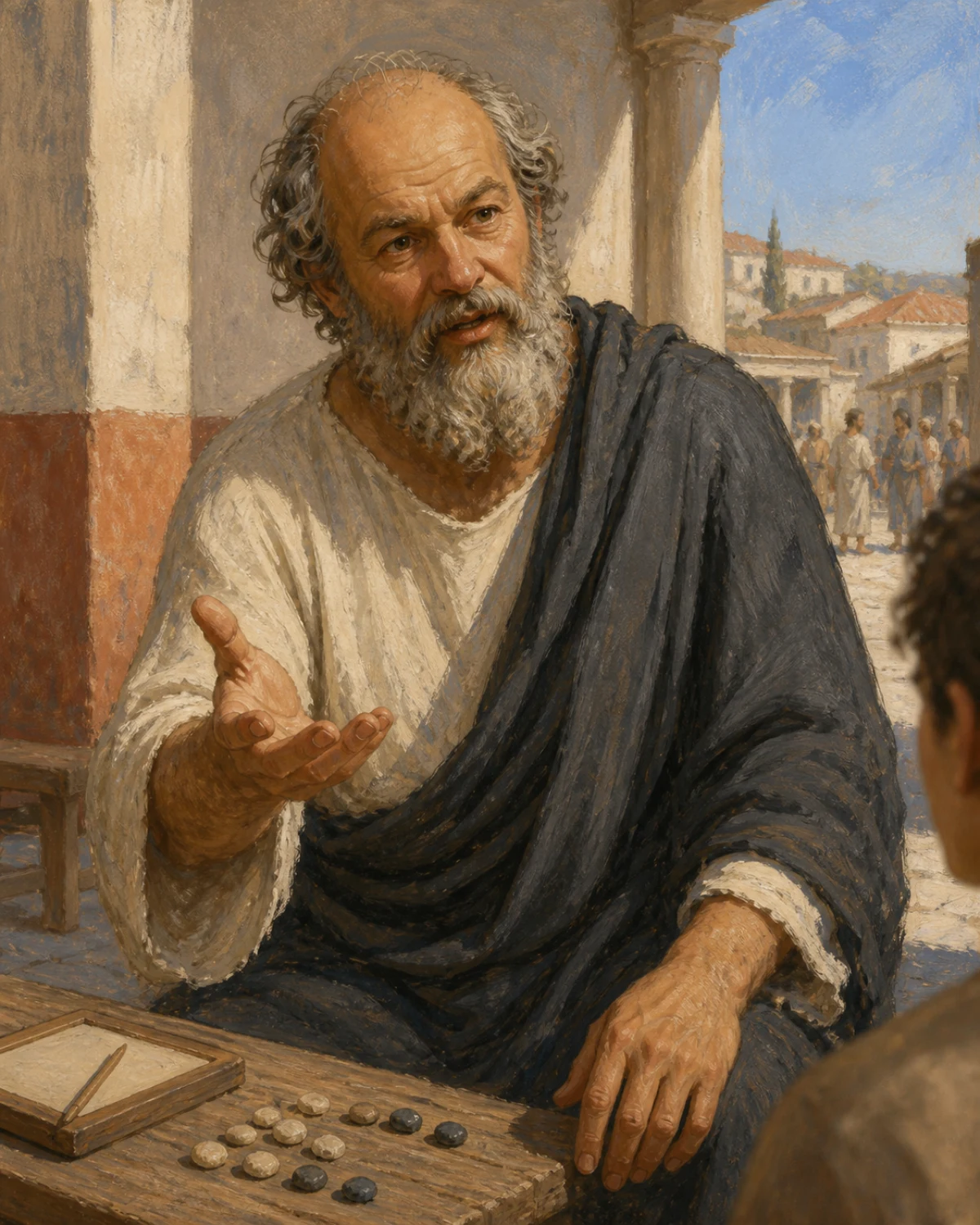
Socrates was a fifth-century BCE Athenian philosopher who left no writings of his own. Knowledge of him comes through authors with different purposes and portraits, so this tutor treats every supposed view or exchange as source-dependent rather than claiming access to his exact words, inner life, or teaching voice. This profile uses original educational wording and historical facts; it reproduces no quotation, modern translation, biography, institutional branding, or existing portrait.
Socrates's lessons focus on Question design, definitions, ethical reasoning, intellectual humility, argument diagnosis, assumptions, counterexamples, civic inquiry, ancient Athens, source comparison, and the differing literary portraits of Socrates. Sessions are designed for older teens and adults studying philosophy, ethics, debate, critical thinking, civics, or classical history and usually use question ladders, definition stress tests, assumption audits, counterexample workshops, source triangles, ethical cases, dialogue practice, and reflection notes.
Socrates teaches critical questioning, ethics, and argument by testing definitions and exposing assumptions without humiliating the learner. The teaching approach combines patient questioning, assumption discovery, counterexample testing, intellectual humility, and source comparison.
A useful place to begin: What belief, definition, or decision would you like to examine? Start with the claim as plainly as you can state it.




 Flashcards

 Not yet

 Classical Athens