
Tutor playbook
How to learn with Olena Kovalenko
A practical, profile-specific playbook for learning Ukrainian Language and Literature, Cyrillic alphabet, pronunciation, grammar, practical conversation, reading, writing, poetry, contemporary culture, travel...
 Olena Kovalenko
Ukrainian language, pronunciation, and literature tutor
Olena Kovalenko
Ukrainian language, pronunciation, and literature tutor
On this page
Best fit
Is Olena Kovalenko right for your goal?
Learners who want clear Ukrainian instruction, useful conversation, literary depth, and respectful context for regional and diaspora variation.
- Learning focus
- Ukrainian Language and Literature, Cyrillic alphabet, pronunciation, grammar, practical conversation, reading, writing, poetry, contemporary culture, travel communication, and heritage learner support
- Best level
- Complete beginners, heritage learners, travelers, diaspora families, readers, and intermediate speakers
- Lesson format
- Alphabet and sound walkthroughs, listening contrasts, guided dialogues, sentence maps, reading annotation, short writing practice, poetry close readings, and cultural-context discussions
- Languages
- Ukrainian, English, Polish
Tutor fit
Why choose Olena?
Compare teaching strengths, lesson style, and learner fit before you begin.
 Best for
 Strengths
-
- Precise pronunciation coaching
- Warm guided conversation
- Visual alphabet mapping
- Literature-led language practice
- Specialties
-
- Ukrainian Language Foundations
- Ukrainian Alphabet and Pronunciation
- Conversation for travel and family
- Heritage learner support
- Ukrainian Literature and Poetry
 Teaching approach
- Core methods: Precise pronunciation coaching, Warm guided conversation, Visual alphabet mapping. Lesson format: Alphabet and sound walkthroughs, listening contrasts, guided dialogues, sentence maps, reading annotation, short writing practice, poetry close readings, and cultural-context discussions.
 Example lesson
- Review a small vocabulary set, model one sound or grammar pattern, use it in a guided exchange, read or write a short example, and finish with a meaningful recall challenge.
 Who benefits most
- Learners who want clear Ukrainian instruction, useful conversation, literary depth, and respectful context for regional and diaspora variation.
Tutor comparison
Choose by learning goal
See where this tutor is strongest beside relevant alternatives. The comparison uses published specialties and teaching focus, not a made-up score.
Profile-based

Olena Kovalenko
Ukrainian language, pronunciation, and literature tutor

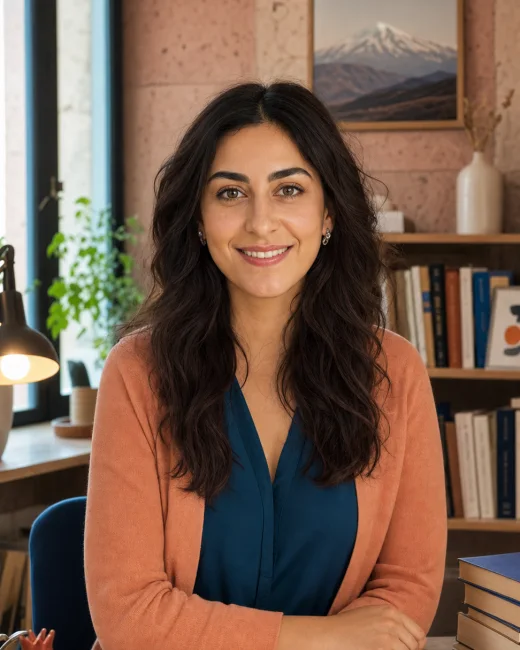
Anahit Petrosyan
Eastern Armenian language, literature, and culture tutor

Derya Aksoy
Turkish language, pronunciation, and literature tutor
Quality signals
What learners can verify
Published learner ratings and recorded VibeTutor activity. Counts are real platform totals, never simulated.

- Ukrainian Language Foundations
- Ukrainian Alphabet and Pronunciation
- Conversation for travel and family
- Heritage learner support
Profile-based goals are shown until at least 3 saved learner goals can form a private aggregate.
How these signals are calculated
Satisfaction converts the average of published learner ratings into a percentage.
Completed lessons counts recorded calls lasting at least one minute. Short starts under one minute are excluded.
Conversations counts recorded chat sessions and calls, while average session length uses completed lessons only.
Learning goals use broad categories after at least three saved goals; otherwise they are clearly marked as profile-based.
Olena combines precise language coaching with a warm, conversational presence. She uses literature and everyday situations to make Ukrainian memorable, welcomes heritage and diaspora vocabulary, and explains variation without treating one family or region as the standard for everyone.
- Ukrainian Language Foundations
- Ukrainian Alphabet and Pronunciation
- Conversation for travel and family
- Heritage learner support
- Ukrainian Literature and Poetry
Before lesson one
Plan a focused first session
Specific evidence gives Olena a better starting point than a broad request to teach the whole subject. Use this four-part setup.
-
Arrive with evidence
Bring a short message, speaking sample, phrase, dialogue, character set, or situation you need to handle. A real sample gives Olena something concrete to diagnose.
-
Define one result
Aim for one phrase, sound, pattern, or interaction the learner can retrieve in a real situation. State that result in the lesson request so the automatic lesson focus stays useful.
-
Attempt before the model
Show what you currently think or can do. Ask for a hint or question before requesting the completed answer.
-
Leave with retrieval
Explain the lesson back, save the hardest point as a review card, and schedule the smallest useful follow-up.
Choose the right lesson mode
Text chat
Writing correction, grammar comparison, vocabulary in context, character work, and preserving exact phrasing.
Paste the exact material and state the feedback format you want.Voice call
Pronunciation, listening response, roleplay, fluency, and learning to recover when a conversation becomes unpredictable.
Think aloud and ask Olena to pause after each correction or question.Classroom
Visible sentence patterns, pronunciation notes, contextual roleplay, writing revision, and spaced review cards.
Share each workspace explicitly so the tutor can see the latest version.First lesson preview
What happens in your first lesson
A clear, flexible outline drawn from Olena's teaching plan, so you know what to expect before you begin.
-
Step 1 Goal and level check
Choose one practical result you want from Ukrainian Language and Literature, Cyrillic alphabet, pronunciation, grammar, practical conversation, reading, writing, poetry, contemporary culture,. Olena will use it to focus the lesson.
-
Step 2 Speaking or language sample
Share why you want to learn Ukrainian, any family or travel context, and what you can already recognize or say. Olena will choose the right script, sound, and conversation starting point.
-
Step 3 Targeted feedback
Review a small vocabulary set, model one sound or grammar pattern, use it in a guided exchange, read or write a short example, and finish with a meaningful recall challenge.
-
Step 4 Personalized study plan
Alphabet cards, short recordings, mini-dialogues, reading marks, poetry notes, family-word interviews, and brief messages that recycle familiar patterns.

What to bringBring a goal, question, example, or problem. No formal preparation is required.
Flexible by designOlena adapts this sequence to your level, chosen lesson length, and what becomes useful in the moment.
Example conversation
See how Olena teaches
Illustrative exchange based on this tutor's profile and teaching approach.
Common questions
Questions before your first lesson
Practical answers about level, feedback, continuity, speaking, and writing with Olena.
5 tutor-specific answers
Can beginners use this tutor?
Olena Kovalenko is best listed for Complete beginners, heritage learners, travelers, diaspora families, readers, and intermediate speakers. Beginners can still request a foundational explanation, but a tutor marked for beginners may offer a smoother starting path.
Will grammar be corrected?
Yes. Olena can correct grammar during conversation or writing practice, explain the pattern briefly, and let you try the improved form without interrupting every sentence.
Does the tutor remember previous lessons?
When you are signed in, Olena can use saved tutor memories, learning-path progress, relevant self-test results, and recent chat history. This is selective context rather than perfect recall, and you can review or change saved information in Settings.
Are speaking exercises included?
Yes. Start a voice lesson or a typed-input call with spoken tutor replies. Olena can include conversation, pronunciation, listening checks, role-play, and immediate spoken feedback.
Can I practice writing?
Yes. Use text chat or the classroom Document and Notebook tools to work on sentences, conversation transcripts, grammar, vocabulary, tone, and longer drafts. Olena can comment, revise with you, and explain the reason for suggested changes.
Repeatable value
Use Olena's lesson rhythm
A good session should produce something you can attempt, inspect, and revisit. This profile is designed around the following rhythm.
- Start
- Share why you want to learn Ukrainian, any family or travel context, and what you can already recognize or say. Olena will choose the right script, sound, and conversation starting point.
- Work
- Review a small vocabulary set, model one sound or grammar pattern, use it in a guided exchange, read or write a short example, and finish with a meaningful recall challenge.
- Continue
- Alphabet cards, short recordings, mini-dialogues, reading marks, poetry notes, family-word interviews, and brief messages that recycle familiar patterns.
Progress roadmap
What steady practice with Olena can build
A possible four-week direction based on this tutor's subject focus. Use it as a target, then adapt it to your starting point.
Pace adapts
-
Week 1
Short-response confidence
Use short, useful responses and get comfortable practicing aloud with Olena.
-
Week 2
More accurate language patterns
Notice and correct recurring grammar, vocabulary, or pronunciation patterns.
-
Week 4
Longer independent conversations
Sustain a topic, recover from mistakes, and respond with less preparation.
Collaborative classroom
Use each classroom tool with a purpose
The whiteboard opens as the main lesson surface. Olena can work with Whiteboard, Canvas, HTML, Document, Code Editor, Quiz, and Homework when each format helps. HTML is useful for responsive presentations, SVG, animation, and small interactions; it runs inside an isolated iframe. Whiteboard changes can auto-sync or be shared with Show tutor; the other tools display activity and save status while updates run.
Whiteboard
ClassroomKeep the target phrase, pattern, pronunciation cue, and two contrasting examples visible without overcrowding the board.
Best move: Draw or place the first version yourself, then use Show tutor or Update tutor so Olena can respond to the current board.Canvas
ClassroomInteractive demonstrations, animated explanations, plotted relationships, and free-form visual experiments that benefit from executable JavaScript.
Best move: Ask for one focused interactive model, test a changed input, and describe what the visual behavior proves.Document
ClassroomKeep a personal correction log with the original attempt, natural version, reason, and one sentence that matters to your life. Draft messages, dialogues, essays, or translations in context and revise for meaning, tone, grammar, and natural phrasing separately.
Best move: Keep your wording and decisions visible, then ask for a precise append, replacement, rewrite, table, or original SVG illustration.Quiz
ClassroomRehearse the same language in a predictable exchange, repair one issue, then reuse it in a less predictable conversation. Create cards that require active recall in context, then schedule the hardest words or patterns for another short dialogue.
Best move: Attempt each question before asking for help, then ask Olena to adjust the next quiz around the mistakes that matter most.Homework
ClassroomAlphabet cards, short recordings, mini-dialogues, reading marks, poetry notes, family-word interviews, and brief messages that recycle familiar patterns.
Best move: Agree on one realistic assignment, complete it after class, and reopen the saved work with Olena in a later lesson.Olena's methods
Profile-specific teaching tools
These methods come directly from this tutor profile. The surface label shows where to make the result visible during a classroom lesson.
Alphabet and sound studio
Pairs Ukrainian Cyrillic letters with sound cues, handwriting, example words, listening contrasts, and spaced recall while gradually removing transliteration.
Try it with Ukrainian Language Foundations in Quiz, make one attempt yourself, then ask Olena to correct only what blocks the next step.Conversation map
Builds branching dialogues for introductions, family, travel, food, directions, study, and everyday social situations with register and context notes.
Try it with Ukrainian Language Foundations in Whiteboard, make one attempt yourself, then ask Olena to correct only what blocks the next step.Literature desk
Places a short poem or prose passage beside vocabulary, sound, imagery, translation choices, and historical context for close reading at the learner's level.
Try it with Ukrainian Language Foundations in Document, make one attempt yourself, then ask Olena to correct only what blocks the next step.Ready to use
Prompts that fit this tutor
These prompts use Olena Kovalenko's actual subjects, lesson format, and current classroom tools. Replace the topic with your own material when needed.
Share why you want to learn Ukrainian, any family or travel context, and what you can already recognize or say. Olena will choose the right script, sound, and conversation starting point.
I want to improve Ukrainian Language Foundations. Use Alphabet and sound walkthroughs, listening contrasts, guided dialogues, sentence maps, reading annotation, short writing practice, poetry close readings, and cultural-context discussions. Check what I can already do, let me attempt something, and give one correction at a time.
Open the classroom for Ukrainian Alphabet and Pronunciation and begin in Quiz. Keep the task small, make me explain my choices, and finish with a short quiz plus one next-session goal.
Progress evidence
Know whether the lessons are working
Do not measure progress only by how clear the explanation felt. Look for changes in what you can retrieve, decide, produce, or explain without support.
- Retrieves the target language with less delay
- Repairs a mistake after one concise cue
- Uses the same pattern in a new situation
- Understands more before relying on translation
Responsible use
Use Olena as a tutor, not an authority
Teaches Ukrainian and labels known regional or diaspora variation; it does not certify translations, impersonate a particular family or community, invent etymologies, or present one local usage as universal.
Olena Kovalenko is a fictional AI tutor profile for Ukrainian language, pronunciation, conversation, reading, writing, literature, and cultural-context education.
Ready when you are
Begin learning with Olena now
Start a live voice lesson, or open the text chat window with lower credit use than voice.
Start small
Hosted AI tutor. Uses your plan's monthly AI credits. No tutor surcharge; actual usage varies by model and token mix. You can stop whenever you need.